


Manufacturer Profile: Mavic Review
Location: Metz Tessy, France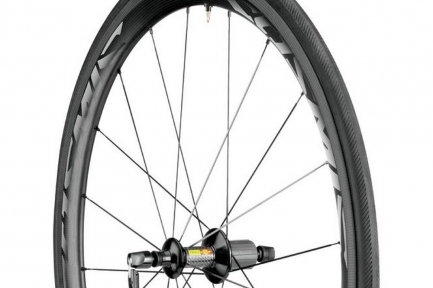
Number of Employees: A significant number.
Materials Used: Carbon and Aluminum.
Point of Origin: France.
Year Started: 1890. First aluminum bicycle rim produced in 1926.
Unique Attributes: The words “bicycle wheels” and Mavic are almost synonymous. Mavic is one of the oldest (since 1890) and most respected brands in the bike industry.
What does “Mavic” mean? Technically, it is MAVIC. MAVIC is an acronym for “Manufacture d’Articles Vélocipediques Idoux et Chanel”. In very loose English, “Pedal Propelled Vehicle Parts Manufacturer that is (was) owned by two folks with the last names Idoux and Chanel”.
Pros of Mavic Wheels:
• Mavic wheels are built around core tenets of reliability and serviceability.
• Mavic’s adjustable cartridge bearing hub design has changed little in almost two decades and it is still the one many other companies mimics.
• From machined brake sidewalls to anodized rims and the Module E rim, Mavic has introduced more concepts that have improved wheel functionality than any other single wheel company.
• Mavic is the inventor of the aluminum rim and the “wheel system”.
• Ubiquitous. Mavic wheels and parts can be found just about anywhere.
Considerations of Mavic Wheels:
• Mavic wheels are rarely the lightest.
• If they didn’t invent it, Mavic is not always quick to adopt new wheel technology – like wider rim profiles.
• Some of Mavic’s most popular models (like the Ksyrium line) can be vertically stiffer (less comfortable and vibration damp) than some rider’s (or frames…) prefer.
• Too many acronyms! Yes, this is a bit tongue in cheek, but Mavic has an acronym (often in French) for just about every part on a wheel.
A Brief History of the Bicycle Wheel System:
Mavic has branched into different categories through the years, they have even produced full groupos (including the forward thinking, but finicky, Zap and Mektronic electronic groups) as well as cycling computers. clothing and shoes. However, wheels and rims are still Mavic’s main focus. The short story as to why we carry Mavic wheels is innovation, lateral stiffness, durability, great rim quality and one of the most user friendly hub designs ever conceived. A bit more detail and history is as follows:
Mavic can take credit for the modern bicycle wheel as much as any company in the business. In 1926, they invented the first production aluminum rim and by the 1930’s they were being used in the Tour de France. While we may look back on this as no big deal, Mavic’s aluminum rims were not just an improvement, they redefined bicycle wheels (thus redefining the bicycle) and allowed for all the technology we have available to us today to be a reality.
Mavic’s Helium wheel in 1996 was arguably the first wheel developed using a system based approach. Mavic had produced hubs and rims for years and the only item they were missing to 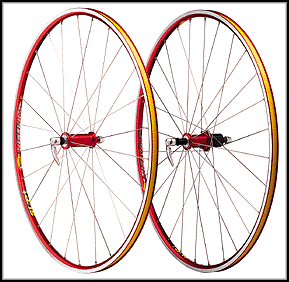 make a full wheel was the spokes. This being said, Mavic’s freewheel only hubs were getting long in the tooth as freewheels were becoming extinct. While Mavic could have just added a cassette body to their 501 hubset and had a nice set of wheels, they realized that they could further improve the design if they stopped trying to make it compatible with pre-existing rims and spokes. The Helium project started from the ground up with a new hubset using 26/28 spokes front/rear (instead of the usual 32 spokes) and that used straight-pull spokes to eliminate the weak link on most spokes (the elbow). Mavic had spokes specifically built to work with this new hub and paired it to a new lighter and stiffer rim design specifically designed simultaneous to the hub. The result was the first factory designed and built wheelset that was round, evenly tensioned and light enough to go head-to-head with the handbuilt wheels that had dominated the high-end wheel market to date. The package was eye-catching with red rims and hubs and was laterally stiffer, for its weight, than most hand-built wheels. The writing was on the wall – the age of the wheel system had come and, like the Coneheads, it came from France.
The Helium sold well and inspired a slew of companies to start producing factory wheels. Mavic, not one to sit back for long, saw that the Helium was more than a trend and they went back to the drawing boards to further improve the concept. Mavic engineers realized that while they had managed to hit their weight target with the Helium, there were still potentially large gains in lateral stiffness and responsiveness to be made. What was holding back wheels from being more laterally stiff (while maintaining a reasonable weight) was not so much rim and hub technology, but spoke technology. The biggest li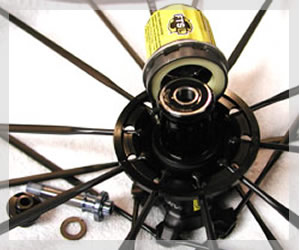 mitation to lateral stiffness was the traditional stainless steel spoke and they knew that they needed to use a new spoke design with a new shape and material if they were going to truly improve stiffness. Seeing the success of the rather traditional appearing Helium (other than the red color), Mavic felt confident enough to allow their engineers to not be restrained by existing designs and let them go about designing the wheel system they wanted to without regard for pre-existing technology. Enter the Ksyrium – Dressed all in matte black, the Ksyrium was like Darth Vader in “The Empire Stikes Back” – seriously evil looking and more than a little powerful. Outside of the cassette body and a few washers and bearings, the Mavic Ksyrium was all alloy. The Ksyrium used a new IsoPulse hub design in conjunction with radical oversized Maxtal spokes that were physically theaded into a new FORE technology rim to create a wheel that was competitively light, but also significantly stiffer than just about anything on the market to date. From hub to rim to spoke, the Ksyrium was built using stiffer materials and design and the result was a wheel that not only looked different, it rode different. After Lance Armstrong rode some of the early pre-production units to victory in a few stages of his first Tour overall win, Mavic knew that the Ksyriu
 m SSC was likely going to be a run-away success.
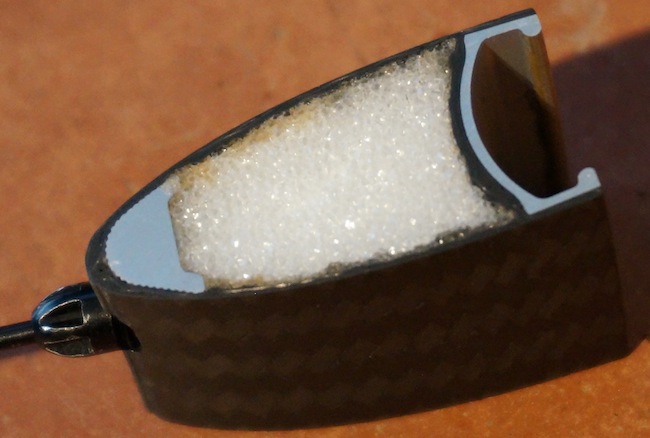
Once the Mavic Ksyrium was developed there was no going back – prebuilt wheel systems became the future of the bicycle wheel. The Ksyrium line continues to be some of Mavic’s most popular wheels and Mavic in general continues to be a major player across many wheel categories having developed other successful wheel systems including the smooth and ultra-light R-SYS as well as their carbon system wheels like the Cosmic and CXR series wheels that employ their own unique approach to aerodynamics, stiffness and durability with TGMAX – one of the only rim designs (along with Corima) to use a durable and stiff foam core.
Key Mavic Wheel Terminology:
Mavic likes acronyms and meaningless (at least in English) abbreviations. Here’s an overview of the most common ones that are used in relation to Mavic wheel technology:
CD – Couche Dure – “Durable Layer”. A process that puts a micro-layer on the rim to improve durability and slows down brake wear. This is more common on Mavic’s rims than their factory built wheels.
CX01 – Mavic’s rim/tire system that fills in the gap between the tire and the rim on their CXR wheels to improve aerodynamics.
Exalith – Mavic’s special rim coating and texture on their top level aluminum rims designed to increase braking performance across all weather conditions and improve rim durability. Exalith rims should be used only with Exalith brake pads.
FORE – Used in most higher end Mavid wheels, FORE is the process of piercing only one wall (the outer) of the rim to affix the spoke. This strengthens the overall rim structure and improves rigidity.
ISOPULSE – Mavic’s patented spoke lacing pattern used in Ksyium Elite, SL and Premium wheels. Designed to keep spoke tension as even as possible and to transmit power as directly from the hub to the rim as possible. ISOPULSE acheives this by using a very rigid spoke design, direct lacing (note the radial laced driveside, only possible with a very rigid spoke design) and feeding the spokes as directly into as rigid as possible a hub body.
ISM – Inter Spoke Milling. Mavic’s patented hub design that removes excess material on the rim between spoke holes to minimize weight without compromising rigidity. 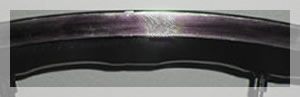 ISM first showed up in the second generation Mavic Ksyrium SSC. In the picture of a Ksyrium SL rim to the left, if you look carefully, you can see that near the spoke nipples and valve stem there is more material than between them. The indented area is ISM.
UB Control – Usine Brut Control – The translation on this does not add up to much, so we’ll just describe it. UB Control is the act of milling the braking surfaces so they are smooth and uniform as possible. This improves braking modulation, consistency and strength and thus minimizes the likelihood of vibrations or shimmy. This is found in the majority of Mavic alloy rim equipped wheels, including the Ksyrium series, R-Sys and Cosmic Carbone and is pictured above (the silver milled braking surface).
MAXTAL – An aluminum alloy that is very light for its weight. A similar alloy has been used on the TGV super trains that rocket people around the French countryside in comfort at high speed. Mavic uses MAXTAL on all Ksyrium wheels that are Ksyrium Elite or better.
SUP – Soude Usine Process – very loosely translated = “Factory Welded Process”. Rims are made from long bent extrusions of alloy. The ends of the extrustion, once bent into a circle, needs to be joined and this can be done through an inexpensive and rough pin joint or by welding. All better quality aluminum rims are welded instead of using looser and less expensive pin joints as welding is more consistent, laterally stiffer, and more durable. When combined with a braking surface milling process like UB Control, a welded rim also offers smoother braking performance and better modulation. SUP is found on all alloy rim Ksyrium, R-Sys and Cosmic wheels.
QRM – “Qualite Roulements Mavic” – Quality Mavic Ball Bearings. Mavic’s standard sealed cartridge bearings that are used in all of their non-adjustable hubs (below Ksyrium Elite).
QRM+ – Mavic’s best quality adjustable sealed cartridge bearing. Used in all wheels Ksyrium Elite or above.
R2R – “Rim to Rim” spoke technology where a carbon spoke spans the full diameter of the rim, bridging the hub. Designed to minimize weight and maximize lateral stiffness, R2R is found on wheels like the Cosmic Carbone Ultimate and Cosmic Carbone SLR.
Zicral – The lightweight and strong alloy used in the Ksyrium spokes.
H2 – Hammer Hardening – A localized hardening of a small section of rim material that is under increased load. Hammer Hardening could be used around the spoke junctures with the rim to minimize cracking at the nipple.
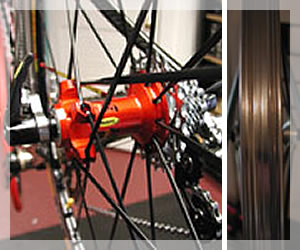
FTS-L – Force Transfer System Light – Mavic’s simple three pawl cassette body design that allows their hubs to be easily disassembled and serviced while providing quick engagement. Pictured below right.
M Cassette Body – Shimano/SRAM compatible cassette body.
ED Cassette Body – Campagnolo compatible cassette body.
MP3 – Mavic’s extended warranty and “no fault” protection program. While no wheel is impossible to destroy and some riders can wreck just about anything, Mavic offers MP3, which costs just 8% of the purchase price of the wheelset and not only doubles the warranty to two years, but also covers almost all “no fault” damage as well. With MP3, no matter how hard you are on wheels, if you choose a well matched Mavic, you won’t have to buy a new pair of wheels for at least two years.
TgMAX – Maximum Glass Transition Temperature. Mavic uses multiple resins to affix carbon and aluminum in a rim structure that is designed to dissipate braking heat as quickly as possible with the intent of providing a carbon rim structure with the braking quality and durability of aluminum.
Mavic makes no-nonsense wheels for people that ride. While not often being the lightest or the most resilient wheels, they are wheels designed to be ridden and require as little maintenance on the rider’s part as possible.
Contact Us for more information on the best wheels for you or to order!
